Micro-frontend architecture is usually discussed in terms of feature-team autonomy. Teams own checkout, account, search results, support, or campaign experiences, and they release independently. That framing is useful, but it often misses the surfaces that users touch first and last.
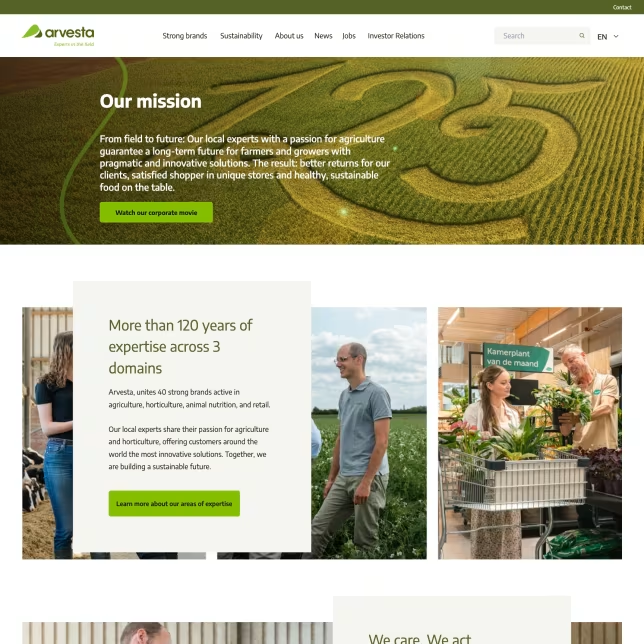
The header, footer, global search entry point, alert banners, country selectors, profile menus, and cross-site wayfinding are not just UI fragments. They are shared contracts. They carry brand signals, route users between domains, expose permissions, emit analytics, respect locale rules, and fail in highly visible ways when something goes wrong.
In enterprise web platforms, these shared shells often become the real coupling point. Product teams may remain independent in local experience areas, but the organization still needs coordinated decisions about what the global navigation is, who can change it, how it is delivered, and how it is rolled back.
That is why shared navigation contracts deserve explicit platform governance rather than informal reuse.
Why shared navigation is different from shared feature code
Shared feature code usually supports a bounded task. A pricing widget, account card, or recommendation module may be reused, but it still lives inside a page or experience owned by a team. If it breaks, the impact is serious but typically localized.
Shared navigation is different because it has platform-level blast radius.
A global header or search shell often affects:
- every page view across multiple domains or sub-brands
- every authenticated and unauthenticated journey
- discoverability of priority content or revenue paths
- analytics consistency across teams
- accessibility at the page-frame level
- regional or market-specific legal and language requirements
It also changes more often than many teams expect. Navigation labels get renamed. Links move. Market switches are added. Alerts appear for incidents, campaigns, or policy requirements. Search entry points evolve as search backends change. What looks like a stable shell is often a constantly negotiated interface between business priorities and technical constraints.
That makes navigation less like a reusable component and more like a shared product with strict operational obligations.
For frontend architects, this means the question is not only, "Can we reuse the header across micro frontends?" The better question is, "What contract do we need so teams can consume a shared shell without inheriting unmanaged release coupling?"
The contract surfaces: labels, links, permissions, locales, analytics, and fallbacks
When teams say they share navigation, they often mean a visual component. In practice, the contract is much broader.
A useful way to govern navigation is to define the contract in layers.
1. Information architecture contract
This covers the semantic structure of the shell:
- primary sections
- utility links
- footer groups
- search entry points
- cross-brand or cross-market switches
- account and authenticated states
- global alerts and emergency messaging
This layer answers what content appears and how it is organized.
2. Content contract
Navigation content is usually dynamic, even when the markup is shared. Teams need rules for:
- labels and microcopy
- destination URLs and routing patterns
- visibility by market, brand, audience, or entitlement
- editorial approval and publishing workflows
- deprecation and migration of old links
A shell that renders from hard-coded labels in a shared React package may work initially, but it often becomes brittle as soon as multiple brands or locales are involved. This is where content platform architecture becomes part of navigation governance rather than a separate CMS concern.
3. Experience contract
This covers behavior rather than content:
- keyboard interaction
- focus handling for menus and overlays
- responsive breakpoints
- mobile versus desktop navigation models
- search open and close behavior
- account state transitions
- loading and skeleton states
This is where design system navigation work meets platform governance. A consistent component API matters, but so do interaction rules that remain stable across host applications.
4. Technical integration contract
This is the part engineering teams usually think about first:
- rendering mode: server-rendered, client-rendered, or hybrid
- data source and schema for nav items
- event model for analytics
- authentication context requirements
- caching and revalidation rules
- fallback behavior when upstream services fail
- versioning expectations for consuming apps
In a Next.js or React-based platform, the shell might need to work across server components, client components, legacy pages, and multiple deployment boundaries. If the contract is underspecified, integration drift follows quickly. Strong React frontend architecture helps make those boundaries explicit.
5. Compliance and observability contract
This layer is frequently underestimated.
Shared navigation often has to support:
- WCAG-conformant semantics and interaction patterns
- consent-aware analytics behavior
- locale and market-specific legal links
- auditability of link changes
- monitoring for failed loads or broken destinations
If your global shell emits analytics differently on three host applications, your reporting is no longer global. If your search trigger is not accessible in one market template, your shell is not actually shared in any meaningful sense.
In other words, frontend shell governance is not just about a component library. It is about controlling the contract across all the obligations attached to that shell.
Shell ownership versus product-team autonomy
One of the hardest organizational questions is ownership.
If nobody owns shared navigation end to end, it becomes a negotiation artifact. Design owns the pattern, content owns labels, a platform team owns the component, product teams own implementation details, and analytics owns tracking requirements. That arrangement can function for a while, but it usually breaks under release pressure.
A healthier model is to assign explicit shell ownership while preserving product-team autonomy in local domains.
In practice, that often means:
- a platform or experience architecture team owns the shell contract
- a design system team owns reusable navigation primitives and interaction standards
- content or digital governance stakeholders approve structural changes and critical labels
- product teams consume the shell through supported integration patterns rather than forking it freely
This does not mean the shell team should control every page. It means they control the global frame and the rules for participation.
A good autonomy boundary looks like this:
- product teams own feature-area navigation within their applications
- shell owners own cross-platform wayfinding and global affordances
- product teams can request shell changes through a governed process
- exceptions are allowed, but they are visible and time-bounded
That balance matters because teams do need room to move. A checkout application may need a reduced header. An authenticated app may need a different account menu. A support area may surface emergency alerts differently. Governance should support valid context-specific patterns without losing the integrity of the shared contract.
The goal is not rigid sameness. The goal is controlled variation.
Runtime delivery options: shared package, edge include, API-fed shell, or host app composition
There is no universally correct runtime pattern for global navigation. The right choice depends on deployment topology, performance goals, change frequency, and operational maturity.
Below are the most common options and their tradeoffs in micro-frontend platform architecture.
Shared package
A shared package is the most familiar model. Teams install a versioned header or footer package from an internal registry and render it within their app.
Advantages:
- simple mental model for React teams
- strong type safety and local development support
- easy integration with design system components
- good fit when navigation changes are relatively infrequent
Tradeoffs:
- every consuming app must upgrade to receive changes
- emergency link or alert updates may require coordinated releases
- package drift can create inconsistent global navigation across properties
- localization, content, and entitlement logic may become duplicated if not externalized
This pattern works well when the UI logic is stable and the content is API-driven, but it becomes risky when the package also contains frequently changing navigation decisions.
Edge include or server-side include
In this model, the shell is composed closer to the edge or server layer and injected into pages at request time.
Advantages:
- faster propagation of global updates
- stronger consistency across brands or applications
- separation between shell release cadence and product app release cadence
- useful for emergency alerts and urgent nav changes
Tradeoffs:
- more infrastructure complexity
- integration with app state and client hydration can be awkward
- debugging ownership boundaries may be harder
- accessibility and focus management require careful end-to-end testing
This model can reduce release coupling, but it introduces runtime coupling and stronger dependency on shared delivery infrastructure. Teams evaluating this route usually need deliberate edge rendering architecture rather than treating includes as a simple implementation detail.
API-fed shell
Here, the host app renders the shell locally but consumes a centralized API or CMS-driven schema for labels, links, alerts, and market variations.
Advantages:
- decouples content change from code deployment
- supports multi-brand and multi-region variation more naturally
- easier to define explicit data contracts and cache policies
- works across several rendering patterns
Tradeoffs:
- host apps still need consistent rendering behavior
- versioning the data schema becomes critical
- failure handling must be designed intentionally
- partial adoption can produce inconsistent experiences
For many enterprise teams, this is a practical middle path. The shell UI can be delivered through a package or host composition, while navigation structure and content come from a governed service.
Host app composition
In this model, the host application composes shell elements from shared primitives and local logic rather than consuming a fully assembled header or footer.
Advantages:
- highest flexibility for contextual adaptation
- easier integration with local routing, auth state, and rendering boundaries
- can work well when brands differ significantly
Tradeoffs:
- highest risk of implementation drift
- repeated effort across teams
- requires strong design system discipline and conformance tooling
- harder to guarantee analytics and accessibility consistency
This is often the most realistic option in large organizations with mixed maturity, but it should be accompanied by explicit conformance checks, documentation, and observable contract tests.
The practical takeaway is simple: do not debate composition patterns in the abstract. Choose based on what changes most often, what must stay consistent, and where your organization is best equipped to absorb complexity.
Release sequencing, incident response, and rollback for global navigation
Shared navigation becomes release coupling when teams ignore operations.
A shell can be beautifully designed and technically elegant, yet still create recurring platform incidents if release sequencing is weak. This is especially true for global headers, search overlays, or alerts because small defects are immediately visible and broadly distributed.
A useful operating model includes the following controls.
Separate code release from content activation where possible
If every label, link, and alert requires an application deployment, you are creating unnecessary risk. Centralized configuration or API-driven content can reduce dependency on synchronized releases.
That said, configuration is not a substitute for governance. Treat the schema, editorial workflow, and publishing permissions as part of the product.
Version the contract explicitly
Whether you use a package, API, or composition layer, define version expectations.
For example:
- which fields are required versus optional
- how deprecated links are handled
- what happens when a new menu type is introduced
- how hosts should render unknown items safely
Backward compatibility matters because not every consuming application upgrades at the same pace.
Design fallback behavior before you need it
A global shell should fail gracefully.
Examples include:
- cached last-known-good navigation when the source service is unavailable
- a reduced static header if personalization fails
- suppression rules for broken alert payloads
- default legal and support links that remain available under degraded conditions
In many organizations, fallback behavior is the difference between a degraded experience and a full platform incident.
Create an incident path for shell-level problems
When a checkout team has an incident, their runbook is usually clear. Shared shells need the same discipline.
Define:
- who can disable a nav item or alert quickly
- who owns investigation when only some host apps are affected
- how monitoring distinguishes content issues from rendering issues
- how rollback works for code, config, and data separately
If the header breaks across several brands, the escalation path should already exist. The shell is a platform surface and needs platform-grade incident response.
Test globally, not only locally
A shell can pass its component tests and still fail in production contexts.
Useful coverage often includes:
- contract tests against nav data schemas
- accessibility checks across keyboard and screen-reader flows
- visual regression for breakpoints and locale expansion
- analytics validation for shared events
- integration testing in representative host applications
This is where global navigation release management becomes concrete. Teams do not need perfect centralization, but they do need consistent operational discipline.
A decision framework for multi-brand and multi-region platforms
In multi-brand and multi-region environments, the challenge is rarely whether to share navigation at all. The real question is how much to standardize, where to permit variation, and how to make those decisions repeatable.
A simple framework can help.
1. Identify what is globally invariant
Some elements should probably remain stable across brands or markets:
- accessibility baseline and interaction behavior
- core analytics event model
- legal and compliance obligations
- critical alerting capabilities
- minimum fallback behavior
These should be governed centrally because inconsistency here produces platform risk.
2. Identify what is brand- or market-variable
Variation is often valid for:
- top-level information architecture
- label language and tone
- promotional or seasonal nav entries
- market-specific help, support, or policy links
- authenticated menu options tied to local offerings
The goal is not to eliminate variation. It is to make variation intentional and supported by the contract.
3. Decide where the source of truth lives
For each part of the shell, determine whether the source of truth is:
- code in a shared package
- a navigation API or config service
- a CMS or editorial workflow
- host application logic
Confusion here causes duplicate ownership and release friction. One contract surface should have one primary source of truth.
4. Match delivery pattern to change frequency and blast radius
Ask practical questions:
- Does this element change weekly or twice a year?
- Does a mistake affect one application or every property?
- Is immediate rollback required?
- Do brands need independent publishing schedules?
High-frequency, high-blast-radius elements often benefit from centrally managed runtime data. Lower-frequency structural behavior may fit better in versioned code.
5. Define conformance, not just guidance
Documentation alone rarely prevents drift.
Conformance can include:
- typed schemas and validation rules
- shared event naming standards
- accessibility acceptance criteria
- reference implementations for Next.js or React hosts
- automated checks in CI where feasible
This is especially important in multi-brand frontend delivery, where local teams may otherwise solve similar problems differently under deadline pressure. Large multi-market programs such as JYSK show how shared component governance, localization, and analytics consistency become platform concerns rather than isolated frontend tasks.
6. Review exceptions as product decisions
Exceptions are not always failures. Sometimes a brand, region, or application genuinely needs different shell behavior.
But exceptions should be:
- documented
- approved by the right owners
- time-bounded where appropriate
- assessed for analytics, accessibility, and support impact
That keeps divergence visible instead of letting it become accidental architecture.
Practical recommendations for implementation teams
For teams modernizing enterprise React or Next.js estates, a pragmatic path usually looks like this:
- Define the shell contract first. Document structure, data schema, interaction rules, analytics events, localization requirements, and fallback expectations.
- Split UI from navigation data. Even if you ship a shared component package, avoid hard-coding high-change content into build artifacts where possible.
- Choose one clear ownership model. A global shell without an accountable owner will accumulate release friction quickly.
- Support more than one runtime pattern only when necessary. If multiple host types must coexist, keep the contract stable even if delivery differs.
- Build rollback into the design. Treat alerts, labels, links, and search entry points as operationally sensitive assets.
- Measure conformance. Accessibility, analytics, and locale behavior should be testable, not aspirational.
These recommendations are deliberately moderate. They do not assume that every organization should centralize the shell completely, nor that every team should assemble its own navigation independently. Most enterprise platforms need a blended model.
Conclusion
Micro-frontend programs usually promise autonomy, but autonomy is never evenly distributed across the interface. Global navigation surfaces sit above feature boundaries, which means they inevitably concentrate shared decisions.
That does not make micro frontends a bad fit for enterprise web platforms. It means the header, footer, search shell, and alert layer should be treated as platform contracts rather than incidental shared UI.
When teams govern those contracts explicitly, they can make better tradeoffs between consistency, speed, and operational risk. They can let product teams move independently in local domains while keeping cross-platform wayfinding, accessibility, analytics, and localization coherent. And they can choose runtime composition patterns based on actual constraints rather than ideology.
In practice, successful micro frontend navigation governance is less about picking the perfect shell architecture and more about making contract boundaries visible. Once those boundaries are clear, release coupling becomes something you can manage instead of something you discover in production.
Tags: micro frontend navigation governance, Frontend Architecture, shared navigation contracts, frontend shell governance, enterprise web platforms, design system navigation