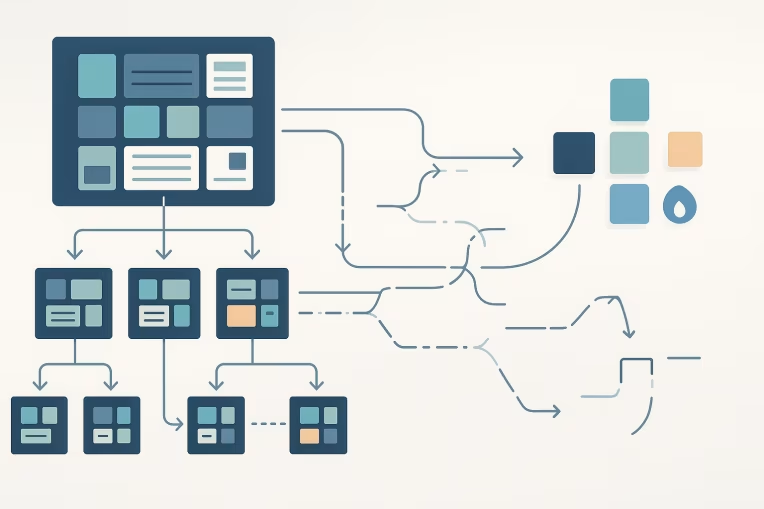
A migration from AEM to Drupal is rarely just a platform move. In enterprise environments, it is also a change to how regional teams inherit content, how local markets diverge from global standards, and how governance is enforced through process rather than policy documents.
That is why AEM Live Copy migration planning deserves more attention than it often gets.
Many organizations know they are using AEM Multi Site Manager concepts, but they do not always have a complete view of how inheritance, rollout triggers, detached branches, or local edits actually shape publishing behavior. Over time, those patterns become part of the operating model. They influence who owns content, when updates are pushed, which markets are allowed to vary, and where approval paths intervene.
If that behavior is not documented before a Drupal migration begins, teams can make the wrong assumptions in both directions. They may try to rebuild every inherited relationship even when it no longer serves the business, or they may flatten complex market dependencies into a simpler Drupal model without understanding the consequences.
The goal is not to chase exact feature parity. In most cases, that would be the wrong objective anyway. The goal is to understand which behaviors are essential, which are compensating for old governance problems, and which can be simplified as part of the move.
Why Live Copy behavior becomes migration risk
Live Copy structures often look like content relationships, but they are also governance relationships.
A parent-child market structure can encode decisions such as:
- which teams can inherit global changes automatically
- which regions require manual review before accepting updates
- which page components are expected to remain shared
- which content areas are routinely localized
- which parts of the site have been detached from the standard operating model
When migration teams treat this only as a page tree problem, they miss the real risk: publishing behavior is being transferred from one platform to another without a shared understanding of how it works.
That creates several common issues.
First, content ownership becomes unclear. A global team may assume it controls updates downstream, while regional teams may depend on local override patterns that are invisible in a high-level site map.
Second, workflow assumptions break. A rollout may have functioned as a de facto approval signal in AEM, even if no one described it that way. After migration, Drupal workflows may be configured around content states and editorial roles, but not around inherited update expectations.
Third, localization cost increases unexpectedly. Teams often discover late in the program that markets are not simply translating content. They are selectively inheriting, partially overriding, or rejecting specific upstream changes.
Fourth, cutover validation becomes harder. If no one can state what should happen when a global page changes, it becomes difficult to verify whether the Drupal implementation is correct.
In short, undocumented rollout behavior turns into migration risk because it affects architecture, governance, workflow, QA, and adoption at the same time.
What to inventory: inheritance, rollout triggers, local overrides, detached branches
A useful rollout configuration audit should not begin with a platform comparison spreadsheet. It should begin with a structured discovery exercise that captures how the organization publishes across markets today.
A practical inventory usually includes four layers.
1. Inheritance structure
Start by mapping the major content relationships.
Document:
- global source sites or master branches
- regional or country-level descendants
- business-unit variations
- exceptions where some markets inherit from different parents
- content types or page templates that follow different patterns
This is the baseline for content inheritance mapping. The purpose is not just to identify hierarchy, but to identify where governance intent is embedded in that hierarchy.
Ask questions such as:
- Which sites are expected to inherit shared structure?
- Which sections are centrally managed?
- Which sections are locally owned?
- Are there different inheritance rules for campaign pages, product pages, support content, or legal content?
Often, the answers vary by content domain more than teams expect.
2. Rollout triggers and update mechanics
Next, document how upstream changes move downstream.
Do not assume all rollouts behave the same way. In practice, organizations often have a mix of formal configuration, manual habits, and editor workarounds.
Capture:
- what kinds of source updates typically flow to child markets
- whether updates are expected immediately, periodically, or after review
- who initiates the process in practice
- which content elements are commonly included or excluded
- whether structural changes are treated differently from text changes
- where teams rely on manual communication instead of system behavior
Even if the implementation details are complex, the migration team needs the operational truth: what business users believe will happen when headquarters updates content.
3. Local overrides and inherited breaks
This is often the most important discovery area.
Many markets inherit a large amount of global content while maintaining local exceptions for pricing, messaging, promotions, legal disclosures, contact details, or product availability. Some exceptions are intentional governance choices. Others are one-off deviations that became permanent.
Inventory:
- fields or components commonly overridden by local teams
- patterns of frequent inheritance cancellation or breakage
- content areas with repeated local edits after rollouts
- components that are technically shared but operationally local
- override behavior tied to language, region, compliance, or product portfolio
This analysis helps distinguish between legitimate localization and structural friction. If local teams constantly override a supposedly shared component, that component may not belong in a shared model.
4. Detached branches and unmanaged exceptions
Detached or loosely governed sections deserve specific attention because they often create false confidence in migration plans.
A program may believe it has a clear global-to-local model, but detached branches can tell a different story. These branches often appear in situations such as:
- acquisitions or merged business units
- markets with unique legal requirements
- emergency campaign structures created outside normal governance
- historical site sections no longer aligned to current standards
If these branches are ignored in discovery, they tend to surface late during content mapping, UAT, or cutover rehearsals.
A good audit flags them early and forces a decision: integrate them into the target model, preserve them as exceptions, or retire them.
Which behaviors should be preserved, simplified, or retired
A migration is a rare opportunity to separate useful governance from accumulated complexity.
That decision should not be framed as "can Drupal do what AEM did?" It should be framed as "which business behaviors should the future platform support, and at what level of operational cost?"
A simple three-part model helps.
Preserve
Preserve behaviors that clearly support business control, brand consistency, or compliance with manageable editorial effort.
Examples can include:
- centrally managed legal or policy content used across regions
- shared structural patterns that keep multisite experiences coherent
- controlled downstream updates for high-risk content domains
- approval checkpoints for sensitive regional publishing workflows
These are the places where the migration team should design Drupal content models and workflows intentionally around the need.
Simplify
Simplify behaviors that have real value but are currently implemented through overly complex inheritance or ad hoc publishing rules.
Examples can include:
- replacing implicit rollout assumptions with explicit workflow states
- reducing deep inheritance chains that are hard to reason about
- narrowing the set of content elements that can inherit automatically
- moving frequently localized content into a model that expects local ownership
This is often the highest-value category. It preserves business intent while reducing hidden dependencies.
Retire
Retire behaviors that exist mainly because the current platform model allowed them to accumulate.
Examples can include:
- legacy branches with no active ownership model
- inherited structures that editors routinely bypass
- exceptions no one can justify or explain
- duplicated publishing steps that are no longer needed
Retiring complexity is not only a technical decision. It requires stakeholder alignment, because some exceptions may be politically sensitive even when they add little operational value.
A strong migration team makes these decisions visible rather than carrying every legacy pattern forward by default.
Mapping AEM market relationships into Drupal content and workflow models
When translating MSM governance and market relationships into Drupal, the safest approach is to map business capabilities first and implementation patterns second.
Drupal may support the target operating model through a combination of content architecture, editorial permissions, workflow states, translation or localization processes, and deployment practices. But the exact design should be driven by required behavior, not by a one-to-one attempt to recreate AEM concepts.
A useful mapping exercise typically covers five areas.
1. Content ownership model
Define who owns each major content domain in the target state.
For each domain, identify:
- global owner
- regional owner
- local approver, if needed
- whether content is centrally created, locally adapted, or locally authored from scratch
This reduces ambiguity and informs both Drupal permissions and editorial workflow design.
2. Shared versus local content boundaries
Determine what should truly remain shared.
Not all previously inherited content should stay centrally controlled. Some content may perform better as reusable source material, editorial guidance, or design system content rather than as directly inherited page content.
The key is to define boundaries such as:
- globally standardized components
- reusable reference content
- region-specific variants
- market-owned pages with optional central guidance
This avoids rebuilding inheritance where a cleaner content ownership split would work better.
3. Workflow and approval paths
AEM rollout behavior sometimes masks process decisions that need to become explicit in Drupal.
For example, a market may previously have received global updates through a rollout pattern but still relied on local editorial review before publication. In Drupal, that may need to be represented as workflow states, approvals, notifications, or release procedures rather than hidden inheritance logic.
Document:
- when local review is mandatory
- when global changes can be accepted without review
- which content categories require compliance approval
- whether publication is centralized or market-driven
This is especially important for regional publishing workflows where organizational responsibility differs by country or business unit, and where governance architecture needs to make those controls explicit.
4. Variant strategy
Some market differences are durable and should be modeled as variants. Others are temporary and may be better handled through campaign operations, scheduling, or editorial process.
A migration team should ask:
- Is this variation persistent across time?
- Does it affect structure, content, or only presentation?
- Is it tied to market, language, legal context, or product availability?
- Does it need independent lifecycle management?
Clear answers help prevent a target-state model from becoming either too rigid or too fragmented.
5. Governance documentation
The target architecture should include a governance artifact that business and delivery teams can understand.
At minimum, define:
- source-of-truth content domains
- local editable areas
- approval responsibilities
- exception handling rules
- retirement criteria for unsupported legacy patterns
This turns migration knowledge into an operating model rather than leaving it inside implementation teams.
Cutover and validation risks when rollout logic is undocumented
Undocumented rollout behavior does not just affect design. It increases delivery risk during testing and cutover.
The biggest problem is that teams cannot validate what they have not defined.
If a market page changes in Drupal after a global update, is that correct behavior or a defect? If a locally edited section no longer tracks central changes, is that intentional or a missed dependency? If a regional team now has to approve content manually, is that acceptable simplification or a broken process?
Without a documented baseline, these questions turn UAT into opinion-based debate.
Common cutover risks include:
- missing local overrides that were embedded in inherited page structures
- over-normalized content models that erase legitimate market differences
- workflows that slow publishing because hidden approval habits were not recognized
- incomplete migration of source-to-market relationships for priority content domains
- post-launch disputes over content ownership and change authority
To reduce these risks, validation should be scenario-based rather than only page-based.
Useful scenarios often include:
- a global content update to a shared policy page
- a regional change to product messaging that should remain local
- a legal or compliance change that requires market review
- a new market page created from a shared template or reference structure
- a previously detached branch being migrated, archived, or rebuilt
Scenario testing forces the program to validate operating behavior, not just content presence.
It is also wise to involve editorial and market stakeholders directly in these tests. They are often the only people who understand the practical meaning of historical exceptions.
A readiness checklist for migration teams
Before implementation goes too far, migration teams should be able to answer a focused set of questions.
Governance and discovery
- Have we mapped the major global, regional, and local content relationships?
- Do we know which site sections rely on inherited behavior today?
- Have we identified detached branches and unmanaged exceptions?
- Can business owners explain why key inheritance patterns exist?
Content and operating model
- Which content domains must remain centrally controlled?
- Which content areas should become locally owned in the target state?
- Where are local overrides frequent enough to justify a different model?
- Have we separated translation needs from true market variation?
Workflow and publishing
- Do we understand current approval paths, whether formal or informal?
- Which publishing actions require local review in the future state?
- Are regional publishing workflows documented clearly enough to configure and test?
- Have we defined who has authority to accept, reject, or modify global updates?
Migration design
- Are we avoiding assumptions about exact feature parity?
- Have we decided which behaviors to preserve, simplify, or retire?
- Is the Drupal target model based on business capability rather than legacy implementation detail?
- Are exceptions handled intentionally instead of deferred indefinitely?
Testing and cutover
- Do we have scenario-based validation for shared and local publishing behavior?
- Have market stakeholders reviewed proposed handling of critical exceptions?
- Can we trace migrated content back to agreed ownership and governance rules?
- Is there a documented fallback plan for unresolved rollout-related edge cases?
If the answer to several of these questions is no, the program is not yet ready to treat migration as a straightforward build-and-move exercise.
Final thought
AEM Live Copy and rollout behavior often represent years of accumulated publishing decisions. Some of those decisions are valuable and should shape the Drupal target state. Others are artifacts of history, unclear ownership, or workarounds that no longer deserve to survive.
The migration team’s job is not to reproduce the past in a different CMS. It is to understand the current operating model well enough to make deliberate choices.
That is why AEM Live Copy migration planning should begin with governance, inheritance, and workflow discovery. When teams audit those relationships early, they can design a Drupal platform that supports real business needs, reduces accidental complexity, and gives global and regional stakeholders a model they can actually explain, govern, and maintain. Programs doing this well usually combine that discovery with structured AEM to Drupal migration planning and scenario-based validation, similar to the multisite governance and rollout discipline seen in Veolia.
Tags: AEM Live Copy migration planning, AEM to Drupal migration, Drupal, MSM governance, enterprise CMS migration, content inheritance mapping