In small applications, rendering mode decisions often feel local. A team has a page, a data source, and a delivery deadline, so it picks SSR, ISR, static generation, or streaming based on what seems easiest in that moment.
That logic breaks down in enterprise programs.
Once a Next.js platform supports multiple product teams, brands, regions, content models, and authenticated journeys, rendering is no longer just a coding choice. It becomes an operating model. The cost of getting it wrong is rarely visible in the first sprint. It shows up later as fragmented cache behavior, unpredictable preview, origin load spikes, inconsistent personalization, and long debugging sessions where nobody is fully sure which layer owns freshness.
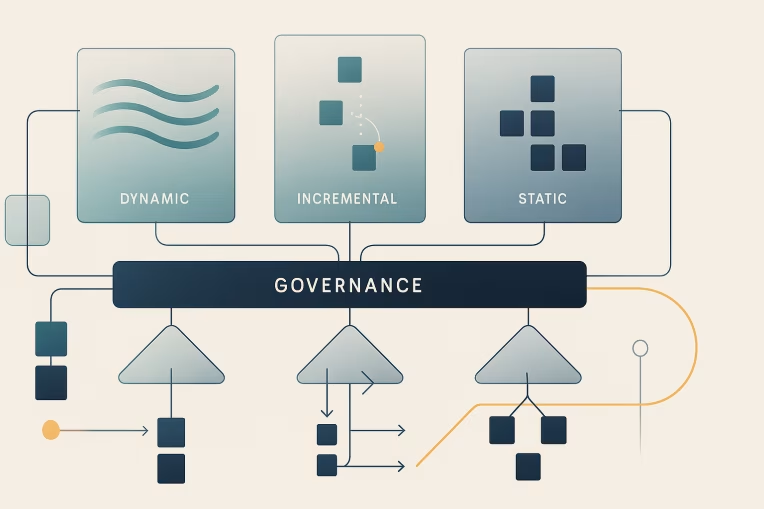
The real issue is not that mixed rendering modes are inherently bad. Most mature platforms will use a mix. The issue is adopting them without a shared governance model.
A practical governance model helps teams answer a few critical questions consistently:
- What kinds of routes truly need request-time rendering?
- Where is stale content acceptable, and for how long?
- Which cache layer is expected to deliver freshness?
- How does preview bypass normal caching safely?
- Who owns invalidation when content, product data, or configuration changes?
- When a route becomes slow, stale, or inconsistent, which team is accountable?
When those questions remain implicit, rendering flexibility turns into architecture debt.
Why rendering mode decisions stop being local
Enterprise web platforms typically aggregate data from more than one system. A single route may combine CMS content, navigation, search state, pricing, inventory, experimentation flags, user context, and regional configuration. Even if a page is owned by one app team, the delivery behavior of that page depends on shared infrastructure and shared data contracts.
That means a rendering decision affects more than local implementation.
For example, choosing SSR for a route can:
- increase dependence on upstream API latency
- shift traffic from edge or CDN layers to origin compute
- complicate failover if one dependency degrades
- make cacheability harder when personalization is mixed with common content
- create release coupling between page code and backend response behavior
Choosing ISR or static generation can create a different class of problems:
- stale content windows that are not acceptable to the business
- inconsistent regeneration timing across regions or route groups
- unclear ownership of revalidation events
- hard-to-debug differences between preview and published states
- dependency on content or commerce webhooks that are not reliably governed
Streaming adds another dimension. It can improve perceived performance and unlock progressive delivery of page sections, but it also introduces new questions about fallback behavior, partial failure handling, observability, and user experience consistency across teams.
In other words, the rendering mode is not just about how HTML is produced. It defines how the platform behaves under change, load, failure, and release.
The operating cost of mixing SSR, ISR, streaming, and static routes
A mixed model is common and often correct. Problems begin when the mix emerges through local optimization instead of shared standards.
A few patterns usually signal governance debt.
Cache fragmentation
Different teams implement different assumptions about cache control, revalidation periods, tag strategies, or bypass rules. Over time, two routes that look similar to a user may behave completely differently under content updates or traffic spikes.
Origin amplification
When request-time rendering is used too broadly, cache misses or uncached variants can multiply backend load. The application may still seem correct functionally, but the platform becomes expensive and fragile at scale.
Release debugging complexity
If a page is wrong after a release, the root cause may sit in code deployment, build-time data, revalidation logic, CDN rules, middleware, or an upstream API. Without a documented rendering contract per route class, incident response becomes guesswork.
Preview unreliability
In headless and multi-brand programs, preview is a critical editorial workflow. It often fails when production caching behavior and preview bypass rules were not designed together. Editors then lose trust in the platform because draft content appears inconsistently or slowly.
Ownership ambiguity
When teams independently choose rendering modes, nobody fully owns the cross-cutting consequences. Application teams may assume platform engineering owns cache behavior. Platform engineering may assume route teams own freshness. Operations teams may be left diagnosing symptoms without enough architectural context.
These costs tend to accumulate slowly. That is why rendering governance is usually under-prioritized until the platform reaches a scale where changing patterns retroactively becomes painful.
Route classification: what actually needs real-time rendering
The most useful governance move is to classify routes before teams choose an implementation pattern.
Many enterprise programs default to technical labels too early: "this page is SSR" or "that page uses ISR." A better starting point is business and operational behavior.
A route classification model can include questions like:
- Does the route contain user-specific data?
- Does the route require request-time authorization or entitlement checks?
- How quickly must published changes appear?
- Can the route tolerate temporary staleness?
- Is the content mostly shared across users, or highly variant by segment, locale, or inventory state?
- Does the route depend on fragile upstream systems?
- Does the route need reliable editorial preview?
- Is the route revenue-critical during traffic peaks?
From there, teams can define route classes instead of ad hoc page choices. For example:
Class A: Broadly cacheable marketing or editorial routes
Typically good candidates for static generation or ISR, provided freshness targets are explicit and invalidation is well governed.
Class B: Content routes with occasional urgent updates
Often suitable for ISR with stronger event-driven revalidation and operational visibility around regeneration success.
Class C: Search, account, basket, or entitlement-driven routes
Usually require request-time logic or a more dynamic composition model because user context materially changes the response.
Class D: Mixed routes with mostly shared content and a few dynamic islands
Often better served by a split architecture, where the shared shell is heavily cacheable and dynamic sections are handled independently.
This classification does not eliminate judgment. It creates a default operating posture.
A common anti-pattern is treating all business-critical pages as SSR because they feel too important to be stale. In practice, that can simply move risk from freshness to reliability. If a route depends on multiple upstream systems, request-time rendering can make the page more operationally brittle exactly when the business needs it most.
Another anti-pattern is forcing ISR onto routes with genuine request-specific data, then layering exceptions until the cache model becomes impossible to reason about. If a route varies materially by user, device, market rules, or entitlement, pretending it is mostly static usually creates more debt than value.
Cache hierarchy, revalidation, and invalidation boundaries
Governance gets real when you define cache hierarchy clearly.
Most enterprise Next.js platforms do not have a single cache. They have several layers that may include:
- browser caching
- CDN or edge caching
- framework-level data caching
- route output caching
- upstream API caching
- CMS or commerce platform delivery caching
If teams only talk about "the cache," they usually miss the actual problem.
A platform governance model should document, at minimum:
- which layer is expected to absorb repeat traffic
- which layer is responsible for freshness for each route class
- what event triggers invalidation or revalidation
- how long stale content is acceptable when dependencies fail
- how cache keys or variants are derived
- how authenticated and anonymous traffic are separated
The most important design principle is to define invalidation boundaries before teams ship implementations.
For instance, if a product detail page includes CMS content, product data, pricing, and localized promotions, do all of those inputs invalidate the same cache entry? Should a CMS change regenerate the entire route? Should a price change bypass page regeneration and refresh only a specific data dependency? Should locale-level navigation changes invalidate every route in that market?
Without explicit boundaries, revalidation becomes either too broad or too narrow.
- Too broad means expensive invalidations, large rebuild or regeneration bursts, and unnecessary origin load.
- Too narrow means inconsistent pages where one section is fresh and another is not, with no easy explanation for stakeholders.
A useful governance practice is to publish a cache contract for each route class. That contract should describe:
- expected freshness target
- allowed stale window
- primary invalidation events
- fallback behavior during failed regeneration or dependency timeout
- observability signals for cache misses, regeneration failures, and origin pressure
This matters especially in multi-brand and headless programs. Shared content models often drive multiple route families, and a single publishing event can have cross-brand consequences. If cache and invalidation rules are not designed at platform level, teams can unintentionally create large invalidation storms or inconsistent brand experiences. That is exactly where edge rendering architecture and static generation architecture decisions need to be treated as governed platform capabilities rather than route-level preferences.
Preview, personalization, and authenticated experience constraints
Preview and personalization are where otherwise reasonable rendering strategies often fail under enterprise conditions.
Preview is not just a developer convenience. In many organizations, it is the editorial proof that the platform is trustworthy. If authors cannot reliably view draft content in the right route, locale, brand context, and component composition, the operational cost lands on support teams and release managers.
Preview governance should answer questions such as:
- How does preview bypass normal cache layers?
- Which draft-capable data sources are supported?
- Are preview sessions isolated by brand, locale, or environment?
- What is the fallback when one upstream source cannot provide draft-compatible data?
- How are preview routes observed and supported operationally?
Teams often underestimate how much rendering mode affects preview. A route may be efficient in production but awkward in preview if the platform has no clean strategy for draft data, bypass cookies or headers, and safe cache isolation.
Personalization introduces a different set of constraints. If pages vary by authenticated user, account state, entitlements, or session context, the default assumption should be caution around shared caching. Not because dynamic delivery is always required, but because the cost of leaking variants or mis-keying cache entries is high.
This is where architecture patterns matter more than labels.
A route does not need to be fully request-rendered just because one section is personalized. In many enterprise cases, a better model is:
- keep the shared route shell cacheable
- isolate personalized sections from shared cache paths
- avoid mixing high-cardinality user variants into whole-page cache keys
- define graceful loading or fallback behavior for delayed personalized content
Streaming can help here when used deliberately. It can support progressive assembly of shared and dynamic sections, especially where some data sources are slower or conditional. But it should not become a way to hide unresolved ownership. If one team streams a slow component without agreed service expectations, the platform may improve initial paint while making the total user journey less predictable.
The governance question is not "can we stream this?" It is "what user promise does streaming support, and who owns the failure mode?"
Ownership model: app teams vs platform team responsibilities
Rendering governance fails when responsibility is either fully centralized or fully decentralized.
If the platform team dictates every rendering choice, delivery slows down and app teams work around the rules. If every app team decides independently, shared infrastructure becomes inconsistent and hard to operate.
A healthier model splits responsibility by concern.
Platform team responsibilities often include:
- defining route classes and approved rendering patterns
- publishing cache and invalidation standards
- providing shared primitives for revalidation, tagging, preview, and observability
- setting guardrails for authenticated and personalized delivery
- monitoring platform-wide origin load, cache efficiency, and route health
- documenting escalation paths when freshness or rendering incidents occur
App team responsibilities often include:
- classifying routes using the shared framework
- documenting route-specific freshness and dependency requirements
- selecting approved patterns based on those requirements
- identifying business-critical invalidation events
- testing preview, failure, and cache behavior for their routes
- participating in incident analysis when route behavior diverges from the contract
The key is that app teams should own business intent, while the platform team owns the consistency of enabling mechanisms.
That split also improves release debugging. When a route has a declared rendering contract, teams can quickly narrow the source of failure:
- If published content is stale beyond the allowed window, is revalidation failing?
- If TTFB increases, is origin compute rising because a route drifted from cacheable to dynamic behavior?
- If preview is wrong, is the issue in draft data access, cache bypass, or route composition?
- If personalized content is inconsistent, did a shared cache path capture user-variant output?
Without those contracts, every incident becomes a full-stack archaeology exercise.
Governance checklist for rendering decisions in multi-team platforms
A lightweight checklist is often more effective than a long policy document. Teams need something they can apply during architecture review, route design, and change approval.
Use a checklist like this before locking a rendering strategy:
-
Classify the route
- Is it shared, user-specific, editorial, transactional, search-driven, or mixed?
- What is the acceptable freshness window?
-
Map all data dependencies
- Which systems contribute to the route?
- Which dependencies are required at request time, and which can tolerate caching or lag?
-
Define the cache hierarchy
- Which layers cache the route or its data?
- What are the cache keys and variant dimensions?
-
Set invalidation rules
- What events refresh content?
- Are invalidations route-level, data-level, tag-based, or webhook-driven?
- What happens if invalidation fails?
-
Test preview behavior
- Can draft content be viewed reliably across environments, brands, and locales?
- Does preview safely bypass or isolate caches?
-
Assess personalization impact
- Does any section require user-specific rendering?
- Can personalized content be isolated from the shared shell?
-
Define failure modes
- If an upstream service times out, does the route fail, degrade, or fall back to stale content?
- Who decides that behavior?
-
Assign ownership
- Which team owns route classification?
- Which team owns revalidation plumbing, observability, and incident response?
-
Instrument the route
- Can the team observe cache hits, regeneration, dependency latency, and fallback states?
- Is there enough telemetry to support debugging after release?
-
Review for anti-patterns
- Full-page SSR for mostly static content
- ISR without dependable invalidation events
- Personalized output in shared cache paths
- Streaming used without explicit UX or failure goals
- Route behavior that differs from the documented class without approval
This checklist turns rendering from a framework feature discussion into a controlled architectural decision. In practice, teams often need this embedded in broader React frontend architecture and headless platform strategy work so route-level choices stay aligned with operating model decisions.
Practical anti-patterns to watch for
Some recurring anti-patterns are worth calling out directly because they often look reasonable in isolation.
"We will decide per team and standardize later."
Later usually means after behavior has fragmented and migrating is expensive.
"SSR is safer because it is always fresh."
Freshness and resilience are different concerns. A request-time dependency chain can be less safe than a controlled stale window.
"ISR solves scale automatically."
It only helps when invalidation, regeneration, and failure handling are designed intentionally.
"Streaming lets us avoid hard route decisions."
Streaming changes the timing of delivery, not the need for ownership, observability, or service expectations.
"Preview is an edge case."
In enterprise headless programs, preview is part of the product operating model. Treating it as secondary usually creates editorial distrust and support overhead.
"If performance is acceptable now, the pattern is fine."
Governance is about repeatability under scale, change, and cross-team growth. A route can perform well today and still be architecturally expensive to operate later.
Closing perspective
The right rendering strategy for an enterprise Next.js platform is almost never a single mode. Most serious platforms need a combination of static delivery, ISR, request-time rendering, and sometimes streaming. The governance challenge is not eliminating that mix. It is making the mix understandable, supportable, and intentional.
That means defining route classes, cache contracts, invalidation boundaries, preview rules, and ownership models before local optimizations harden into platform behavior. It also means recognizing that rendering decisions shape operational reality as much as user experience.
When teams govern SSR, ISR, streaming, and static delivery as platform capabilities rather than personal implementation preferences, they reduce a class of debt that is otherwise easy to miss: cache and ownership debt. And in large frontend programs, that debt often determines whether the platform remains scalable not just in traffic, but in people, process, and change. Multi-brand delivery programs such as Organogenesis show how quickly release governance, platform consistency, and rendering choices become intertwined once multiple sites and teams share the same foundation.
Tags: Next.js rendering strategy governance, Frontend Architecture, Enterprise Next.js, SSR, ISR, Streaming, Cache Strategy, Platform Governance