A publish button can succeed while the release itself is still incomplete.
That is one of the most common operational gaps in enterprise headless delivery. Content moves to a published state in the CMS, but a required locale is still missing. A component query passes preview but fails in production because the contract changed. Search results still show stale versions of the page. The CDN serves the new route, but a related navigation fragment has not been invalidated. Analytics for the newly launched module has not been wired, so the team can no longer measure what they shipped.
In a monolithic stack, some of these dependencies were hidden behind a single deployment or publishing workflow. In a headless platform, responsibilities are deliberately separated across systems and teams. That separation improves flexibility and scale, but it also creates a dangerous illusion: because one system says "published," everyone assumes the release is complete.
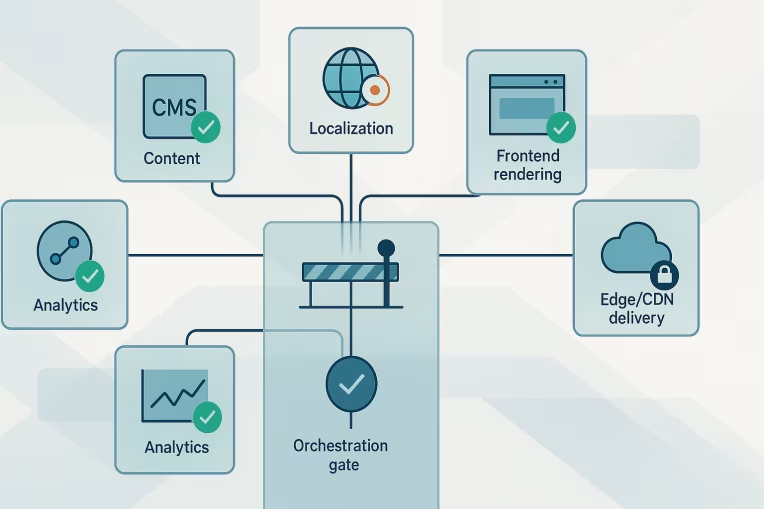
For enterprise platforms, headless publishing readiness gates are the control layer that closes this gap. They do not replace editorial workflows or engineering release processes. They sit across them, defining the minimum conditions that must be true before a release is treated as genuinely live.
The goal is not to slow teams down. The goal is to make release quality measurable, automatable, and visible enough that teams stop relying on launch-day vigilance and institutional memory.
Why a successful publish can still be an incomplete release
A publish event is usually a state change inside one system. A complete release is an end-to-end outcome across several systems.
That distinction matters more as platforms mature. Multi-brand, multi-locale, or multi-team environments often involve:
- a CMS or several CMS instances
- a modern frontend application
- search and indexing pipelines
- personalization or audience logic
- localization workflows
- analytics and tag management
- edge caching, revalidation, or CDN invalidation
- downstream content consumers such as apps or syndication endpoints
When those pieces are loosely coordinated, a page can be marked published while still failing key business expectations.
A practical example: an editorial team publishes a product launch page. The page record is valid in the CMS, but the frontend component expects a normalized CTA object that was recently changed by another team. Production rendering degrades silently for one variant. Search is updated on a schedule and does not reflect the launch for several hours. The French locale was approved late and missed the release window. From the CMS perspective, the page is live. From a customer perspective, the release is inconsistent.
Readiness gates exist because enterprise releases are not single actions. They are coordinated outcomes.
The systems that must agree before content is truly live
The exact list varies by platform, but most enterprise headless ecosystems need alignment across five control areas.
1. CMS and content model validity
The published content item should meet the expected structural and editorial rules, not just basic field validation.
Typical gate criteria include:
- required fields populated for the content type
- references resolved and not pointing to archived or unpublished dependencies
- taxonomy or metadata required for routing, search, or personalization present
- publish dates, embargoes, and expiry rules valid
- editorial approval states complete where governance requires them
This is broader than form validation. It is release validation.
2. Frontend rendering readiness
Content can be technically valid in the CMS and still fail in the delivery layer.
Typical checks include:
- route generation succeeds
- required components exist in the consuming application
- API responses match expected contracts
- design system variants referenced by content are supported
- preview and production rendering assumptions are consistent
- performance or asset budgets for critical templates stay within acceptable thresholds
This is especially important when platforms support reusable component-driven pages. A single unresolved contract issue can affect many pages at once.
3. Localization and regional completeness
For multi-market organizations, published rarely means universally ready.
Typical checks include:
- required locales exist for the release type
- market-specific legal or compliance fields are complete
- fallback behavior is explicitly approved, not accidental
- translated slugs, metadata, and search labels are present where required
- locale-specific navigation, redirects, and hreflang behavior are valid
If the operating model allows partial market release, the gate should reflect that intentionally rather than assuming all locales ship together.
4. Search and discoverability readiness
A page being live but undiscoverable is often treated as a search problem later, when it should be part of release completeness upfront.
Typical checks include:
- search indexing job triggered successfully
- expected fields mapped to the search schema
- noindex or exclusion flags aligned with the release intent
- canonical rules and metadata complete
- key search facets or content type filters updated if relevant
- freshness expectations defined for urgent versus routine content
Search gates do not need to wait for every ranking outcome. They should verify that the content can be found as designed and that the indexing pipeline is not stalled.
5. Edge and delivery propagation
The final customer experience often depends on edge behavior more than on CMS state.
Typical checks include:
- CDN invalidation or cache revalidation completed
- static generation or incremental rebuild completed where applicable
- API cache layers refreshed for affected routes or fragments
- shared navigation, breadcrumbs, or listing pages updated
- redirects and rewrites deployed if the release changes routing
- origin and edge responses consistent for the release path
Without this layer, teams can mistake partial propagation for a completed launch.
Common failure modes: missing locales, broken preview assumptions, stale search, unresolved component contracts
Most readiness issues are not exotic. They are repeatable operational patterns.
Missing locales treated as acceptable by default
A global team publishes in the default language, assuming translations will follow shortly. The platform has no gate that distinguishes a staged regional rollout from an incomplete global release. The result is a launch that looks complete in reporting but is partially absent in key markets.
A better approach is to define release classes:
- single-market launch
- core-language launch with planned locale follow-on
- all-market launch
Each class should carry different locale requirements and different exception rules.
Preview works, production fails
Preview environments often hide delivery issues because they use tolerant rendering logic, mock data, or bypassed caching layers. Teams approve content based on preview behavior that does not accurately represent production.
A useful readiness gate is not simply "preview passes." It is "the production delivery path can render the published content shape without unresolved dependencies."
That may require contract validation against live APIs, production-like rendering checks, or automated smoke tests on affected templates.
Search remains stale after publish
Enterprise teams often accept search lag as normal, but the business impact varies. A thought leadership article may tolerate delayed indexing. A campaign landing page, support article, or recall notice may not.
This is why readiness gates should reflect content criticality. Search freshness expectations can be tiered, such as:
- immediate or near-immediate validation for time-sensitive content
- scheduled validation for standard editorial publishing
- deferred indexing for content intentionally hidden from internal or public search
The point is not to promise zero lag. It is to define what lag is acceptable for the release type.
Unresolved component or schema contracts
Component-driven headless platforms often fail at the boundaries between teams. CMS schema changes, frontend assumptions, and API contracts can drift independently.
Common examples include:
- a field changes from optional to required in practice but not in schema enforcement
- a frontend component expects a new variant not yet deployed to production
- a list item references a card type missing required search metadata
- a page template relies on a route parameter or slug pattern that has changed
These are not content errors or frontend errors alone. They are integration errors, and readiness gates should treat them that way.
Designing readiness gates by release type
One of the biggest mistakes is implementing readiness as a single universal checklist.
Not every release carries the same risk, and not every team needs the same controls. A governance model that treats a routine article update the same way it treats a major product launch will either create unnecessary friction or be ignored.
A better model defines readiness gates by release type.
Low-risk editorial update
Examples:
- copy corrections n- metadata updates
- non-critical article publishing
Potential gate set:
- content validation passes
- route resolves successfully
- analytics defaults present if required
- search submission queued
- no blocking dependency changes detected
This keeps routine work moving quickly.
Standard content release
Examples:
- new landing page
- campaign article series
- resource center update
Potential gate set:
- all content validation rules pass
- required locales for the target market complete
- production-like render check passes
- search indexing event confirmed
- cache invalidation or revalidation confirmed
- SEO metadata and canonical rules validated
This is often the default pattern for enterprise publishing.
High-risk or high-visibility launch
Examples:
- homepage takeover
- product launch
- regulated content release
- migration cutover page set
Potential gate set:
- all standard release checks
- cross-system dependency verification completed
- release window and rollback path confirmed
- analytics instrumentation validated for new modules
- navigation and supporting pages updated
- search freshness verified within defined SLA or operating expectation
- exception approval captured if any non-blocking requirement is waived
The value of tiering is that it makes governance proportional. Teams can move quickly on low-risk work while applying more rigorous control where the customer, legal, or commercial impact is greater.
Operational ownership across CMS, frontend, search, and edge
Readiness gates fail when they belong to no one or when one team is unfairly expected to validate everything.
A practical operating model separates control ownership from execution ownership.
For example:
- Content operations can own editorial state rules, publishing workflows, required metadata, and locale completeness expectations.
- Frontend engineering can own template rendering checks, component compatibility validation, route generation, and user-facing smoke tests.
- Search or platform teams can own indexing triggers, schema mappings, discoverability validation, and freshness monitoring.
- Infrastructure or platform operations can own edge propagation, caching rules, revalidation, and deployment-related release signals.
- Analytics owners can define which release classes require instrumentation validation before content is counted as fully live.
This matters because readiness is not a feature toggle in a single tool. It is an operating agreement across the platform.
For organizations using Drupal, WordPress, or a headless CMS, the implementation details will differ, but the ownership model is similar. The CMS may initiate the workflow, yet several downstream systems provide the signals that determine whether the release is complete.
A useful governance pattern is to define three things for every gate:
- What is being checked
- Which team owns the rule
- What happens when it fails
That third point is where many models break down.
Metrics, automation, and exception handling
If readiness cannot be measured, it will quickly become subjective.
Teams should define a small set of operational metrics that show whether the gating model is improving release quality or simply adding ceremony.
Useful measures often include:
- percentage of releases that pass all gates on first attempt
- most common failed gate categories
- time from publish request to fully live state by release type
- number of manual exceptions raised per month
- search freshness confirmation time for time-sensitive releases
- production incidents traced back to missed readiness checks
The best metrics create learning loops. If component contract failures are rising, that is not just a launch issue; it may signal a schema governance issue. If locale exceptions are constant, release planning may be unrealistic. If search freshness delays repeatedly block launches, the indexing architecture may need attention.
Automate the checks, not just the approvals
Many organizations digitize approvals but leave the real validation manual. That creates a false sense of control.
A stronger model automates the measurable parts of readiness, such as:
- schema and field completeness validation
- linked content dependency checks
- route and render verification for affected pages
- indexing event confirmation
- cache revalidation confirmation
- basic SEO metadata validation
- locale coverage checks against release targets
Manual review still matters where judgment is required, but the repeatable checks should not depend on launch-day spreadsheets or chat messages.
Design explicit exception paths
No enterprise platform should assume every gate must always be blocking. There are legitimate cases where teams need to release with known gaps.
Examples include:
- a legal deadline requires publication before all search enhancements are in place
- a market-specific locale is intentionally deferred with executive approval
- analytics instrumentation for a secondary module is scheduled for immediate follow-up
- a low-risk display issue is accepted temporarily during a broader launch window
The critical point is that exceptions should be explicit, time-bound, and visible.
A useful exception model typically records:
- the failed gate
- why the release is still proceeding
- who approved the exception
- the remediation owner
- the deadline for closing the gap
That turns exceptions into governed decisions rather than hidden release debt.
A phased adoption model for enterprise teams
Most organizations should not attempt to implement a fully mature readiness model in one step.
A phased approach is more realistic.
Phase 1: Define release-critical failure modes
Start by identifying the problems that most often make a publish incomplete.
Examples:
- missing required locales
- broken rendering on key templates
- stale search after urgent releases
- unpublished referenced content
- missing redirects on route changes
This phase is about narrowing focus, not documenting every possible risk.
Phase 2: Create a minimum viable gate set
Pick a small number of checks that are high value and relatively objective. Often that means:
- content dependency validation
- target locale completeness
- route and render validation
- search trigger confirmation
- edge revalidation confirmation
This baseline already prevents many avoidable launch issues.
Phase 3: Classify releases and apply proportional controls
Introduce release types so not every publish carries the same burden. Align gate strength to business risk, customer visibility, and operational complexity.
This is usually where organizations begin to see better editorial velocity, because friction becomes more predictable and more justified.
Phase 4: Integrate signals into workflows and dashboards
Once the rules are clear, surface them where teams already work. That may be in CMS workflows, release dashboards, deployment pipelines, or shared operational reporting.
The goal is simple: teams should not have to guess whether something is fully live.
Phase 5: Mature with exception handling and trend analysis
At this stage, the platform can shift from reactive policing to continuous improvement. Failed gates, overrides, and time-to-live metrics become inputs for architectural and process decisions.
This is where platform owners often uncover broader needs in headless architecture, search integration, frontend engineering, or content operations. Readiness data reveals where the operating model is under strain.
Putting readiness gates to work without slowing everyone down
Effective readiness gates do not turn publishing into bureaucracy. They clarify what "live" actually means in a distributed delivery model.
For enterprise digital platforms, that clarity is increasingly essential. As CMS, frontend, search, and edge concerns become more specialized, the cost of weak release coordination rises. Teams spend more time chasing partial launches, reconciling conflicting system states, and explaining why a publish looked successful while the experience was still incomplete.
A good readiness model solves this by making release quality observable.
It gives editorial teams confidence that speed does not come at the expense of consistency. It gives engineering teams a clearer contract between content structure and delivery behavior. It gives platform owners a way to govern releases without centralizing every decision into a single approval bottleneck.
Most importantly, it changes the definition of success. Success is no longer that the CMS accepted a publish event. Success is that the intended experience is complete across the systems that matter.
That is the real promise of headless publishing readiness gates: not more process for its own sake, but a safer and more scalable way to ship across multi-team platforms.
Tags: Headless, Enterprise digital platforms, Headless publishing readiness gates, Content operations, Frontend engineering, Search integration