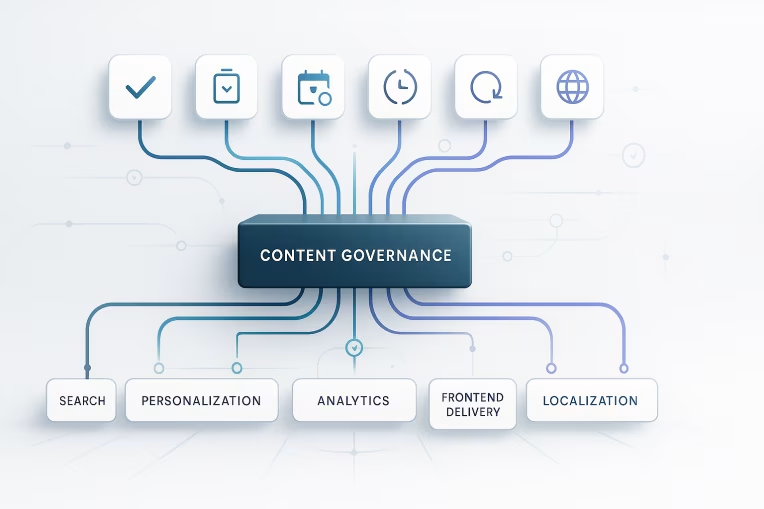
In many headless implementations, teams talk about "publishing" as if it were a single, universal action. In practice, it rarely is.
A CMS editor may think publish means "this page is now live." A frontend team may interpret it as "rebuild the route." A search team may treat it as "reindex this document." A personalization platform may assume it means "activate new audience-targeted variants." Analytics or CDP pipelines may record it as a content milestone. None of those interpretations is inherently wrong, but they are not the same thing.
That gap is where drift begins.
When lifecycle meaning is vague, downstream systems respond inconsistently. Search indexes retain content that has been removed from the live site. Cache invalidation fires when only metadata changed. Static builds run on editorial drafts that were never intended for production. Rollbacks restore page content but not related derived assets or localized entries. Over time, the platform appears unpredictable even when each individual component is technically functioning.
The root problem is usually governance, not transport. Webhooks, queues, and event buses can move messages reliably, but they do not define what a message means. That meaning has to be designed, documented, versioned, and owned.
For enterprise digital platforms, especially those spanning headless CMS, Drupal-to-headless transitions, composable architectures, and multiple consumer systems, content events should be treated as governed contracts.
Why content events become a platform contract problem
In a small implementation, a simple webhook can be enough. One content repository sends a payload to one frontend, and the receiving application knows what to do. At enterprise scale, that simplicity disappears.
A single content change can affect:
- live web delivery
- preview environments
- search indexing
- edge cache invalidation
- static site generation or incremental builds
- analytics and content performance reporting
- personalization rules and audience decisioning
- syndication feeds
- downstream product, campaign, or support experiences
Each of those consumers cares about a different aspect of the lifecycle. Some need to know that content is publicly visible. Others need to know that a localized variant changed. Others need to know that a previously valid item is now withdrawn but should remain historically traceable.
If teams collapse all lifecycle transitions into a generic publish signal, consumers are forced to infer meaning from incomplete context. That creates hidden assumptions in every integration.
A governed event taxonomy solves this by separating two concerns:
- Business lifecycle meaning: what changed in the content state.
- Technical delivery mechanics: how that change is transported to consumers.
That distinction matters. A queue retry, webhook delivery success, or event bus acknowledgment is not the same as a content lifecycle event. One describes message movement. The other describes a change in publishing state that downstream systems must interpret correctly.
The event types most teams collapse into a single "publish" signal
Many platforms start with a single outbound event because it is fast to implement. The CMS sends something like content.published, and every subscriber builds its own rules around that one message.
The issue is that the same signal often gets used for several materially different scenarios:
- first-time publication of a new entry
- update to an already live entry
- metadata-only change with no rendering impact
- scheduled release reaching its effective time
- republish after rollback
- unpublish or withdrawal
- archive for retention purposes
- restore from archive
- locale-specific publication
- structured content change that affects many derived pages
From an operational perspective, these are not interchangeable.
For example, search may need a delete action for unpublish, but not for archive if the content should remain available in certain controlled channels. A static build pipeline may need a full dependency rebuild when a reusable component changes, but only a targeted route refresh when a page body changes. Personalization systems may need variant re-evaluation only when eligibility fields change, not for editorial typo fixes.
The more downstream consumers you have, the more costly ambiguity becomes.
Event taxonomy design: publish, update, unpublish, archive, restore, schedule, rollback, locale change
A useful event taxonomy does not need to be huge. It needs to be clear, stable, and tied to meaningful lifecycle transitions.
A practical starting model often includes the following event families.
1. Publish
Use publish for the moment content becomes active for a defined delivery scope.
That scope should be explicit. Publish can mean:
- globally available in production
- available only in a locale
- available only in a channel or site
- available only after an approval and effective date
If the platform uses multiple environments, distinguish publishing to production from publishing to preview or staging. Those are different states with different downstream effects.
2. Update
Use update when already active content changes but remains active.
This is often the event that teams incorrectly fold into publish. Keeping it separate helps subscribers make better decisions. An update may trigger:
- targeted cache purge n- route re-render
- search partial reindex
- analytics content dimension refresh
It may not require activation workflows that first-time publication does.
3. Unpublish
Use unpublish when content should no longer be available in a live delivery context.
This event should answer critical questions:
- Is the content removed from all public channels?
- Should search documents be deleted or merely hidden?
- Should consumers preserve historical analytics references?
- Does unpublish affect only one locale or channel?
Unpublish is a business lifecycle event. It should not be approximated by silence, TTL expiry, or the absence of a later publish event.
4. Archive
Archive is often confused with unpublish, but they represent different intent.
Archived content may be retired from active use while still retained for audit, reuse, migration, or internal access. Some downstream systems may do nothing with archive. Others may move the item into a lower-priority index, remove it from navigation feeds, or adjust lifecycle reporting.
Separating archive from unpublish prevents systems from making destructive assumptions.
5. Restore
Restore covers the transition from a previously inactive or archived state back into an active or recoverable state.
This matters because restore is not always identical to first-time publish. Downstream systems may need to:
- rehydrate previously removed documents
- restore edge routes and derived pages
- repopulate personalization inventories
- recalculate dependencies for linked content
Treating restore explicitly also improves auditability.
6. Schedule
Scheduling can be modeled in two ways:
- as a state-setting event, such as
scheduledwith an effective timestamp - as a later execution event when the scheduled change actually takes effect
Most enterprise teams need both concepts. Consumers that prepare assets ahead of time care about the schedule definition. Consumers that expose live content care about the effective transition.
Without that distinction, teams often trigger live behavior too early.
7. Rollback
Rollback is a high-value event in enterprise operations because it is rarely just a content edit.
A rollback may mean:
- reverting to a prior approved version
- restoring a prior snapshot of a page and its referenced components
- reversing a bad campaign release
- undoing a localization mistake
Subscribers need to know that the new state is actually a reversion. Search, cache, and analytics consumers may treat rollback differently from a normal update because the semantic meaning is "return to previous known state," not simply "new content revision available."
8. Locale change
Locale changes are often missed entirely in initial models.
In multilingual platforms, content state can differ by locale. One locale may be published while another remains draft, or one translation may be rolled back independently. If the event model only describes entry-level state, downstream consumers cannot act accurately.
Locale-aware events can carry:
- affected locale
- fallback behavior
- whether the source entry changed or only a translation variant changed
- whether route availability changed in that locale
For global platforms, locale precision is essential.
Required payload fields and idempotency keys
A governed taxonomy needs governed payloads. Consumers should not have to reverse-engineer meaning from whichever fields happen to be emitted by the current CMS integration.
A practical event contract typically includes these fields:
eventType: the lifecycle event name, such ascontent.publishorcontent.unpublisheventVersion: contract version for compatibility managementeventId: globally unique identifier for the event instanceoccurredAt: timestamp for when the lifecycle transition occurredsourceSystem: originating platform or domain capabilityenvironment: preview, staging, production, or another defined environmentcontentId: stable content identifiercontentType: page, article, component, taxonomy term, asset, or another model classlocale: affected locale or locale setchannelorsite: the delivery scopestateBefore: previous business lifecycle state when availablestateAfter: resulting business lifecycle staterevisionIdorversionId: source revision referencecorrelationId: identifier tying related events together across a workflowcausationId: identifier showing which prior event or process triggered this eventeffectiveAt: useful for scheduled activation or deactivationchangedFields: optional list of fields or domains affecteddependencyScope: optional indicator of whether referenced content requires broader invalidation or rebuild
Not every consumer needs every field, but the contract should make important distinctions available.
Idempotency is especially important. In distributed systems, duplicate delivery is normal. Replay is normal. Retry is normal. Consumers must be able to process an event more than once without causing incorrect results.
Useful idempotency patterns include:
- a stable
eventIdfor each emitted event instance - a separate business key such as
contentId + revisionId + eventType + locale + channel - consumer-side deduplication windows
- upsert rather than blind insert behavior in downstream indexes and projections
If a publish event is replayed, the outcome should remain correct. If an unpublish arrives twice, it should not break the consumer. If an older update arrives after a newer one, version comparison rules should prevent state regression.
Mapping events to search, edge cache, preview, analytics, and personalization consumers
The value of a taxonomy becomes clear when you map event meaning to consumer action.
Different subscribers should react differently to the same lifecycle contract.
Search indexes
Search consumers usually care about visibility, locale, canonical URL, taxonomy metadata, freshness, and deletion state.
A good mapping might look like this:
publish: create or activate searchable documentupdate: partial or full reindex depending on changed fieldsunpublish: remove document from public index or mark unavailablearchive: move to non-public retention index or no-op depending on search designrestore: reinsert or reactivate documentlocale change: update locale-specific document slicerollback: reindex using restored revision state
The contract should help search avoid guessing whether content is truly live.
Edge cache and CDN invalidation
Cache systems care about what paths, fragments, APIs, or derived responses are affected.
Generic invalidation of everything is costly and can hide modeling issues. Event payloads should support targeted invalidation through route references, dependency scope, or content relationship metadata.
Examples:
- a page update purges specific routes
- a shared component update purges all dependent routes or relevant content API responses
- an unpublish invalidates route, feed inclusion, and edge-rendered fragments
- a locale-only change purges only locale-specific paths
Preview systems
Preview should not consume production publish signals as if they were draft updates.
Preview often needs separate events or filtered subscriptions for:
- draft save
- preview snapshot generation
- approval readiness
- scheduled content pending activation
This is a common place where governance fails. Teams accidentally blur editorial collaboration signals with public delivery signals.
Analytics and reporting
Analytics consumers may care less about route invalidation and more about content identity, lifecycle milestones, and attribution consistency.
For analytics, events can support:
- tracking first publish date versus later updates
- recording withdrawal or archival date
- distinguishing content refreshes from net-new launches
- correlating campaign release windows with content state changes
If analytics only receives a repeated publish signal, downstream reports often lose lifecycle nuance.
Personalization and activation layers
Personalization platforms often depend on content eligibility, audience rules, region, timing, and channel state.
These consumers need more than "content changed." They need to know whether:
- a variant is newly available
- an audience-targeted offer should be withdrawn
- locale availability changed
- a scheduled activation is approaching or effective
- a rollback should revert active experiences to a prior configuration
This is why content event governance is an operating model issue. One taxonomy can serve many subscribers, but only if the business semantics are explicit enough to support each consumer class.
Failure handling, replay, and reconciliation patterns
Even well-designed contracts fail operationally if the platform assumes perfect delivery.
Enterprise content event architectures should plan for delayed messages, duplicate events, out-of-order delivery, partial subscriber outages, and mismatches between source state and downstream projections.
A resilient model usually includes three layers.
1. Delivery resilience
This is the transport layer concern.
Typical patterns include:
- retries with backoff
- dead-letter handling
- subscriber acknowledgment and timeout controls
- observability for failure rate, latency, and backlog
Important, but not sufficient on its own.
2. Replay capability
Teams should be able to replay historical events intentionally.
Replay is useful when:
- onboarding a new downstream consumer
- rebuilding a search index
- recovering from subscriber outage
- repairing a projection after a contract bug
Replay only works safely when event meaning is stable and consumers are idempotent.
3. Reconciliation
Some failures cannot be solved by replay alone. If a consumer missed a deletion, processed out of order, or derived state incorrectly, you need reconciliation against the source of truth.
Practical reconciliation patterns include:
- periodic comparison of live CMS state to public search index state
- route availability audits between content repository and frontend delivery layer
- locale completeness checks across channels
- dependent asset and page rebuild verification
- discrepancy reports for content marked published in source but absent in target systems
A strong platform does not assume events are always enough. It supplements event-driven flows with deliberate state verification.
Governance model: ownership, versioning, and change control
Taxonomy quality depends on ownership.
If no one owns event semantics, integration drift is inevitable. Each consumer team will fill in the blanks differently, and the contract will fragment over time.
A workable governance model often includes:
- Platform owner: accountable for lifecycle definitions and cross-system alignment
- Domain contributors: CMS, frontend, search, analytics, and activation leads who validate consumer impact
- Contract documentation: event catalog, field definitions, examples, and edge-case behaviors
- Versioning policy: explicit rules for additive versus breaking changes
- Change review: governance checkpoint before altering event meaning or payload fields
- Consumer conformance: validation that subscribers handle supported versions and required fields correctly
Versioning deserves special discipline.
You do not need to version every tiny payload addition as a major change, but you do need rules. For example:
- additive optional fields can typically be introduced in-place
- renamed fields, removed fields, or changed event semantics should trigger a versioned contract
- changing the meaning of
publishwithout changing the event name is usually the most dangerous choice
In enterprise programs, event contracts should be treated much like APIs: documented, reviewed, backward-aware, and tied to release management.
Signals that your current event model is already drifting
Many teams do not notice taxonomy drift until incidents pile up. The earlier warning signs are usually visible in operations.
Watch for patterns like these:
- downstream teams asking what
publish"really means" - search and frontend disagreeing on whether content is live
- different subscribers filtering the same event in incompatible ways
- repeated manual reindex or cache flush interventions
- rollback procedures requiring custom scripts for each consumer system
- locale-specific defects that do not reproduce in the default language
- schedule-driven launches that appear early in one system and late in another
- audit or analytics teams unable to identify first publish versus later refreshes
- integration logic filled with vendor-specific field guessing rather than stable contract handling
If those symptoms are present, the problem is rarely just webhook reliability. It is usually that lifecycle semantics were never formalized strongly enough.
A practical way to implement this without overengineering
Teams do not need an elaborate enterprise event council before improving the model. A phased approach is usually enough.
Start with four steps.
- Inventory current signals and consumers. Document every publish-related trigger leaving the CMS and every subscriber action tied to it.
- Define lifecycle states in business terms. Clarify what publish, update, unpublish, archive, restore, schedule, rollback, and locale change mean for your platform.
- Create a minimal governed contract. Standardize event names, required fields, idempotency rules, and versioning approach.
- Map consumer behavior explicitly. For each subscriber, define the expected action per event type and identify gaps that need reconciliation or dependency metadata.
From there, add replay and conformance testing.
This approach works well in enterprise headless environments because it improves clarity without locking teams into a specific tool or messaging product. Whether your architecture uses webhooks, queues, an event bus, or hybrid integration patterns, the contract can remain stable.
That is the real goal: portability of meaning.
When content lifecycle events are governed as contracts, downstream systems stop reacting to vague signals and start responding to deliberate platform intent. Search becomes more accurate. Cache invalidation becomes more targeted. Preview remains separate from production release semantics. Rollbacks become safer. Localization becomes more predictable.
In other words, the headless platform becomes easier to trust.
That trust does not come from sending more messages. It comes from defining what the messages mean, who owns that meaning, and how every consumer is expected to act on it. In practice, that usually sits within broader headless CMS architecture, static site generation architecture, and CDP platform architecture decisions rather than inside a webhook alone.
Tags: Headless, headless content event taxonomy, content event governance, publish event contracts, event-driven CMS integration, enterprise digital platforms