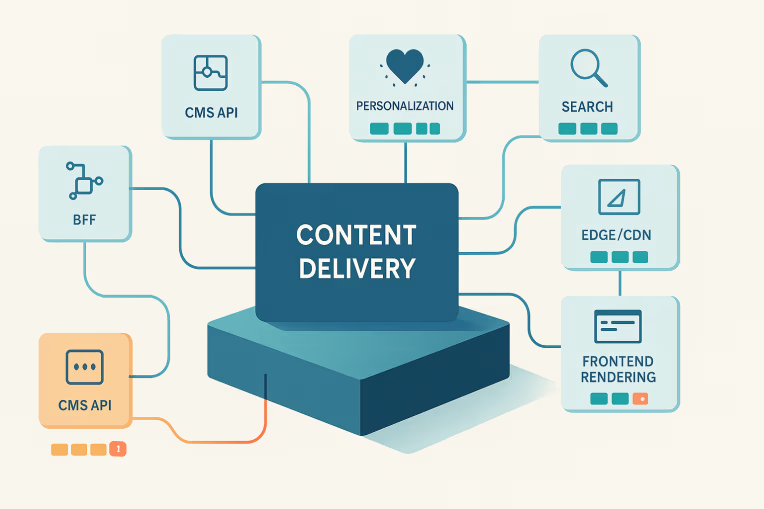
Modern headless platforms are rarely a single application talking to a single CMS. In enterprise environments, content delivery often depends on a chain of services: a CMS API, a GraphQL or BFF layer, search infrastructure, personalization or profile services, feature flagging, CDN behavior, and frontend rendering at the edge or origin.
That architecture creates flexibility, but it also changes how reliability should be managed.
If each team only measures the uptime of its own service, the platform can appear healthy while editors cannot publish, pages render without critical content, search results go empty, or personalization failures slow down requests that should have fallen back gracefully. In other words, isolated availability numbers can hide real business impact.
This is where headless content API error budgets become useful. Instead of treating every dependency incident as equally severe, teams define how much failure or degradation is tolerable for specific user journeys, then use that budget to guide prioritization, escalation, release decisions, and fallback design.
The key shift is simple: reliability should be measured at the experience level, not just the component level.
Why uptime alone hides editorial and customer impact
A headless stack can have multiple services reporting strong uptime while still failing important outcomes.
Consider a few common situations:
- The CMS API is available, but publish events are delayed and the site serves stale content longer than editorial policy allows.
- The BFF responds successfully, but it times out on enrichment calls and returns pages missing critical product or campaign modules.
- Search infrastructure is reachable, but index freshness lags enough that recently published content cannot be discovered.
- Personalization is slow or unavailable, and page render time increases because fallback behavior was never defined.
- A CDN continues serving cached pages, masking upstream instability until a purge or revalidation event exposes the problem.
None of these examples are well described by a simple question like, “Was the API up?”
For enterprise digital platforms, reliability usually needs to support at least three distinct constituencies:
- Customers, who care whether pages load, content is accurate, and journeys complete.
- Editors and marketers, who care whether content can be published, updated, previewed, and discovered on time.
- Platform teams, who care whether the system can evolve safely without making every release feel operationally risky.
Error budgets help connect those interests. They force a discussion about which failures matter most, which degradation is acceptable, and which incidents truly consume limited reliability capacity.
Map the content delivery path: CMS, BFF, search, personalization, edge
Before defining budgets, map the full delivery path for the journeys you actually need to protect.
For a typical headless implementation, the dependency chain might include:
- Authoring and publish systems such as a headless CMS, or a traditional CMS exposed through APIs.
- API aggregation layers such as GraphQL gateways or BFF services that normalize content and assemble page models.
- Search and indexing services that control findability and often feed listing pages, site search, or related-content modules.
- Personalization and profile services that influence variant selection, audience targeting, or recommendation modules.
- Media and asset delivery layers including image transformation, DAM integration, and CDN-backed delivery.
- Frontend rendering infrastructure such as SSR applications, edge rendering functions, static regeneration pipelines, or client-side hydration paths.
- Caching and edge controls including CDN behavior, revalidation rules, purge mechanics, and failover policies.
Do not model this only as a technical diagram. Model it as a set of flows.
For example, a useful reliability map usually includes at least these flows:
- Publish flow: editor saves content, approval occurs, content is published, downstream systems update, cache is invalidated or revalidated, and live pages reflect the change.
- Render flow: visitor requests a page, routing resolves, content model is assembled, optional enrichments are applied, assets load, and the page returns in an acceptable state.
- Freshness flow: new or changed content becomes visible across detail pages, listing pages, search, feeds, and edge caches within expected time windows.
- Discovery flow: content appears in search, navigation, related content modules, or recommendation surfaces.
This flow-based view matters because a single dependency may play different roles in different journeys. A search outage may be critical for discovery pages but not for content detail pages. A personalization service may be important for conversion optimization while remaining non-critical for baseline rendering.
Once the flows are visible, teams can stop assuming every dependency must behave perfectly at all times.
Define critical vs optional dependencies and acceptable degradation
The most practical reliability improvement many headless teams can make is to separate critical dependencies from optional dependencies.
Critical does not mean “important in theory.” It means the journey fails in a way users or editors cannot reasonably tolerate if the dependency is unavailable or too slow.
A simple way to classify dependencies is to ask:
- If this dependency fails, can the page or workflow still complete?
- If it can complete, is the result still acceptable for the intended audience?
- How long can degraded behavior continue before it becomes a business issue?
- Does the failure affect all traffic, a subset of routes, a subset of users, or only internal workflows?
A common classification model looks like this:
- Tier 1: hard-required — without this dependency, the journey should be considered failed.
- Tier 2: soft-required — without this dependency, the journey can continue in a degraded but acceptable form for a limited period.
- Tier 3: optional — the dependency adds value, but its failure should not block the primary page or workflow.
Examples in a headless context:
- Core CMS content for a legal page is usually hard-required.
- Related content modules may be soft-required.
- Personalized recommendations are often optional if the page still renders well without them.
- Search indexing may be hard-required for search experiences and soft-required for content freshness elsewhere.
- Preview infrastructure may be hard-required for editorial workflow but irrelevant to customer-facing runtime.
This classification should lead directly to explicit degraded modes.
Acceptable degraded modes might include:
- serving cached or stale content during upstream API instability
- omitting non-critical modules when enrichment calls exceed latency thresholds
- switching from personalized to default content variants
- isolating problematic routes or page sections rather than failing the entire response
- delaying non-essential content freshness while preserving baseline page availability
The point is not to normalize poor quality. The point is to define in advance what “graceful enough” looks like so the platform can fail predictably instead of chaotically.
Turn SLIs into error budgets for publish, render, and freshness flows
Error budgets work best when they are attached to service levels that reflect real outcomes.
For headless platforms, useful SLIs often sit above infrastructure metrics and focus on end-to-end behavior. Rather than tracking only raw API uptime, define indicators for the flows that matter.
Publish SLIs
These can help measure editorial reliability:
- percentage of publish actions that successfully propagate to live delivery paths
- time from publish confirmation to content availability on live pages
- success rate of preview generation or preview retrieval
- percentage of cache invalidation or revalidation events completed within target windows
These indicators matter because editorial reliability is not just about whether authors can log in. It is about whether content operations behave predictably enough to support campaigns, corrections, and routine publishing.
Render SLIs
These focus on user-facing delivery:
- percentage of page requests returning a usable response
- percentage of page requests with all hard-required content present
- percentage of requests successfully completing with soft-required components allowed to degrade
- latency distributions for page assembly and downstream dependency fetches
In composable architectures, a render SLI should often distinguish between:
- full fidelity success
- acceptable degraded success
- journey failure
That distinction is essential. If a page loads with core content and safe defaults but without recommendations, many businesses should count that differently from a blank page or error response.
Freshness SLIs
Freshness is especially important in headless ecosystems because multiple caches and indexers can hide lag.
Useful freshness indicators can include:
- percentage of content updates visible on live pages within a defined window
- percentage of search index updates completed within target time
- maximum age of cached content served for specified route classes
- percentage of navigation, listings, or feeds reflecting recently published items within target windows
Once SLIs are defined, the error budget is the tolerated level of non-conformance over a period. The budget should not be identical for every flow.
For example:
- publish propagation may need a tighter budget during heavy editorial periods
- personalized recommendation completeness may tolerate more degradation than core page assembly
- search freshness may have different expectations than homepage rendering
The exact numbers depend on the business context, but the governance pattern is consistent: tie budget policy to user and editorial impact, not to architectural neatness.
A useful implementation habit is to define budget consumption rules in plain language, such as:
- a full route failure consumes more budget than a soft component fallback
- stale content served within an approved stale window may consume no budget or only a reduced amount
- missing hard-required content consumes budget immediately
- optional dependency failure consumes budget only if it breaches agreed degraded-mode thresholds
This approach avoids one of the most common mistakes in distributed delivery platforms: overreacting to non-critical component incidents while underreacting to failures in freshness or editorial operations.
Fallback patterns: stale content, partial rendering, cached defaults, route isolation
Error budgets are only useful if the platform has technical patterns that make graceful degradation possible.
In headless systems, several fallback approaches are especially practical.
Stale content serving
If content was previously valid, serving stale content for a bounded period is often better than failing a page request because a CMS or BFF dependency is temporarily unstable.
This requires:
- clearly defined stale windows by content type or route class
- visibility into whether stale responses are being served intentionally
- policy exceptions for content that must never remain stale, such as compliance-sensitive or time-bound material
Stale serving should be treated as a deliberate product decision, not an accidental cache side effect.
Partial rendering
Not every module deserves equal priority.
A robust page assembly layer can render the shell and core content even when secondary modules fail. This is often easier when page composition is designed around explicit dependency tiers instead of a single all-or-nothing response model.
Examples include:
- rendering the article body while hiding a failed related-content block
- returning product details without recommendations or social proof modules
- showing a campaign landing page with default messaging when audience targeting fails
The requirement is that the degraded state should still be coherent, accessible, and safe.
Cached defaults
Some services, especially personalization and feature selection systems, benefit from a known-good default behavior.
Cached defaults can include:
- default audience variants
- baseline navigation structures
- last-known-good configuration for content modules
- precomputed page models for high-traffic routes
This pattern prevents optional or soft-required dependencies from introducing hard failures.
Route isolation
Enterprise sites often have route classes with very different operational needs: homepage, campaign pages, search, article detail, product detail, account areas, and editorial preview.
Route isolation allows teams to contain failures instead of escalating all incidents to platform-wide severity.
For example:
- a search dependency issue may affect search routes without changing the severity of article detail pages
- preview instability may trigger editorial support without requiring customer-facing incident posture
- a problematic personalization integration may be disabled for one route family while the rest of the site remains fully operational
This is one of the clearest ways to align reliability policy with actual impact.
Practical implementation note
Whether the frontend is built with Next.js, another SSR framework, or a custom delivery tier, the principle is the same: dependency behavior should be encoded into rendering policy. Timeouts, fallback content, route-level isolation, and cache strategy should be first-class design decisions, not emergency patches added during incidents. That kind of delivery policy usually sits at the intersection of edge rendering architecture and React frontend architecture.
Ownership and incident policy across platform teams
Cross-service error budgets fail when nobody owns the user journey end to end.
In composable platforms, responsibility is often split across CMS teams, frontend teams, platform engineering, search teams, personalization teams, and SRE or operations. That split is normal, but it creates two risks:
- every team optimizes local reliability while gaps remain at the journey level
- incidents trigger debate about ownership instead of a predefined response
A better model is shared governance with explicit decision rights.
At minimum, teams should agree on:
- which journeys are budget-governed
- which dependencies are hard-required, soft-required, or optional for each journey
- who approves degraded-mode behavior
- who can disable an optional dependency in production
- which events consume budget and at what severity
- when budget exhaustion changes release posture or escalation rules
This is where editorial stakeholders should be involved. Content operations leaders often understand freshness tolerance, campaign sensitivity, and preview expectations better than infrastructure teams alone.
A practical incident policy might distinguish between:
- customer-visible route failures
- customer-visible degradation within approved fallback
- editorial workflow failures
- freshness breaches without render failure
- optional dependency instability with no meaningful experience impact
Those categories help avoid the trap of making every incident either “critical” or “ignore it.”
They also improve post-incident review quality. Instead of asking only which service went down, teams can ask:
- Did the platform degrade as designed?
- Did the budget policy classify impact correctly?
- Were stale or fallback behaviors acceptable?
- Did editorial and customer impact match what the architecture assumed?
That feedback loop is what turns error budgets into a design tool rather than just a reporting construct.
How to introduce error budgets without slowing delivery
Many teams resist error budgets because they assume the process will add governance overhead or block releases. In practice, that usually happens only when budgets are introduced as a compliance exercise instead of an operational simplification.
A lightweight rollout tends to work better.
Start with one or two high-value journeys
Choose flows where reliability disputes already happen, such as:
- publish-to-live propagation
- article or product detail rendering
- site search freshness and availability
Do not try to model every dependency across the entire platform at once.
Define degradation before defining dashboards
Observability matters, but teams often start with telemetry and never align on acceptable failure. First decide:
- what must always work
- what may degrade
- what fallback is acceptable
- when degraded behavior becomes unacceptable
Only then define dashboards and alerts that reflect those decisions.
Use existing architecture boundaries
You do not need a complete replatform to apply this thinking.
Teams can often begin by:
- adding route-level dependency classification
- setting stricter timeout boundaries for optional downstream services
- introducing cached defaults for enrichment calls
- instrumenting publish and freshness latency separately from runtime availability
- documenting manual and automated dependency disablement paths
These are often the same kinds of changes addressed in composable architecture strategy work, where ownership boundaries and dependency policies need to be made explicit.
Keep policy language understandable outside engineering
If editorial, product, or delivery leaders cannot understand the policy, it is unlikely to hold up under pressure.
Statements such as these are more useful than purely technical targets:
- “Campaign pages may serve previously published content for a limited period during CMS API instability, but scheduled launch content requires tighter freshness handling.”
- “Recommendation failures must not block page delivery.”
- “Preview availability is tracked separately from live site render health.”
- “Search result freshness is an editorial reliability issue, not just a search team metric.”
Review budget consumption during normal delivery cycles
Error budgets become operationally valuable when they influence prioritization.
If a route or workflow repeatedly burns budget because an optional dependency behaves like a required one, that is a design problem worth fixing. If freshness budget is regularly consumed after releases, release quality and invalidation strategy may need attention. If budget remains consistently healthy, teams may gain confidence to move faster.
The goal is not more process. The goal is clearer tradeoffs.
A practical framing for enterprise headless reliability
Headless and composable architectures do not remove reliability concerns; they redistribute them across more services, teams, and failure modes.
That is why uptime alone is too narrow a measure.
A more useful approach is to define reliability around the journeys the platform exists to support: publishing, rendering, freshness, and discovery. From there, teams can classify dependencies by criticality, define acceptable degraded modes, and assign error budgets based on real editorial and customer impact.
When done well, this creates several advantages:
- incidents are prioritized more rationally
- optional dependencies stop causing unnecessary severity inflation
- degraded modes become intentional architecture, not improvisation
- editorial reliability gets treated as part of platform reliability
- release decisions can reflect actual user risk instead of isolated component noise
For enterprise digital platforms, that is the real value of headless content API error budgets. They create a shared language for deciding what must work, what can bend, and how the platform should behave when one part of a composable system is inevitably less reliable than the rest. Teams that need to operationalize those decisions across content models, APIs, and delivery layers usually end up treating it as a broader content platform architecture concern rather than a narrow monitoring exercise. A useful reference point is the Alpro platform, where publishing efficiency, search integration, and static delivery patterns had to stay aligned as the headless stack evolved.
Tags: Headless, Reliability Engineering, Composable Architecture, CMS, BFF, SRE, Edge Delivery, Platform Architecture